Tibet Overland Tour Combined Everest Base Camp Adventure
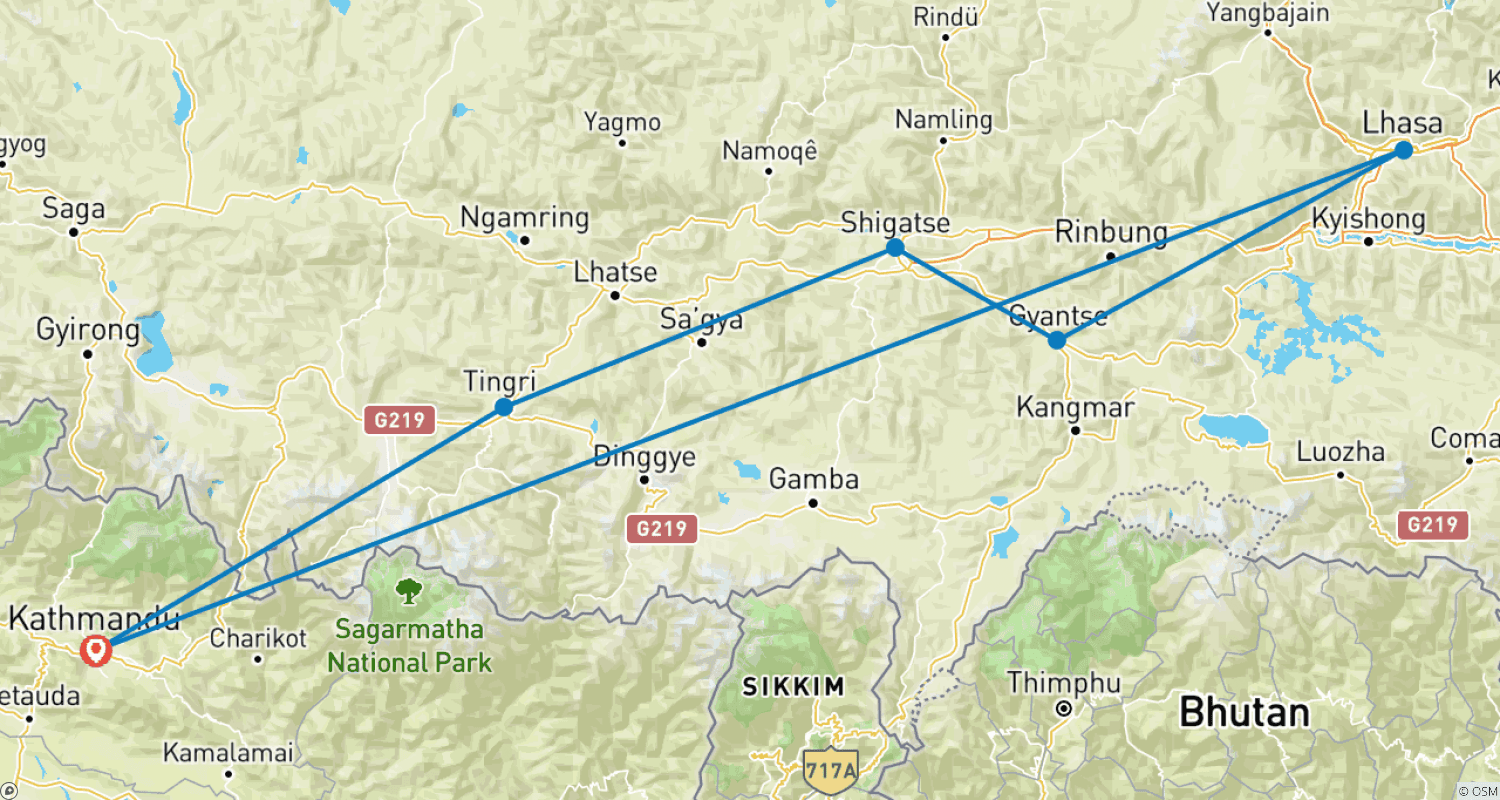
ゼガル · シガツェ · ギャンツェ · ラサ · カトマンズ
ツアー概要
Tibet, a rich and beautiful land, is located at the main part of Qinghai - Tibet plateau, south - west frontier of China. Tibet possesses more than fifty peaks above 7,000m among which eleven are over 8,000m and located with an average altitude over 4,000m above sea level. Tibet borders with Sichuan, Yunnan, Qinghai and Xinjiang to the south contiguous to India, Nepal, Sikkim, Bhutan and Burma, and bounded by Kashmir on the west. The Tibet Autonomous Region with a population of two and half million, mainly of Tibetans, and an area 1.2 million sq. km.
Tibet is rich in natural resources and owns a vast expanse of landforms. People living on this land have been creating a glorious culture since ancient times. Tibet has a long history, majestic mountains and rivers, regular customs and habits, wonderful natural landscapes with monks clad in robes and yellow hats are seen everywhere. If you were to set foot on this virgin land, to follow the steps of pilgrims dating, from ancient times, to visit the great temples an monasteries, to enjoy the unique culture, to have sips of waters from those limpid rivers and lakes, to sight the different customs and -to trek around those mighty snow clad peaks, you would surely be intoxicated with their wonders. Now a days Tibet is linked with most major city by Air and also by Overland. The common entry point to Tibet is Chengdu and Nepal by both Air and Land.
Traveling in Tibet is an adventure involving high altitude and thin air, and could be strenuous at times. While most visitors have only minor effects from altitude, those with known heart, lung and blood disease should consult their doctors before traveling. Mild headache loss of appetite or stomach disorder can take place before acclimation. In such cases, drink plenty of water do not over exert yourself, take deep breaths, and take more rest than usual. We recommend that you carry warm clothes such as jackets and sweaters, sunglasses, chopsticks, sun tan lotion, Swiss knife, water bottle, and a small medical kit.
VISIT Xiger and Everest Base Camp
The view from the top is incredible with uninterrupted views stretching from Makalu to Shishapangma. Below the pass, Everest initially is hidden from view, but as we turn the corner into the Rongbuk Valley it reappears, more impressive than ever.Just how often do you get a chance to sit and read at 5000m and with the stunning view of Everest's north face.
Visit Shakya Monastery:
It lies 143km to the Southwest of Shigatse. Shakya Monastery, the center of the Sakya order of Tibetan Buddhism, was founded in 1073 by Konchok Gyalpo. During the rule of the Sakyapas the priest patron relationship between Tibet and China was established. Skyapa rulers reigned over Tibet for nearly a hundred years from 13th -14th century. Many of its priceless images frescos, statures, holy scriptures remaining today date back to the time of its founding.
Visit Tashilhunpo Monastery
Tashilhunpo Monastery is the biggest Gelugpa monastery in the Tsang region of Tibet. It is located in the town of Sigatse and was founded by Gedun Drup, a disciple of Tsongkapa, the founder of the Gelungpa Sect. Gedun Drup is recognized as the first Dalai Lama. It was first built in 1447 and continuously expanded by the successive Panchen Lamas. The Ngagpa College (Tantric College), one of its four monastic colleges, is the residence of the Panchen lamas. The most amazing image in this monastery is the statue of the giant Maitreya (Future Buddha) erected by the 9th Panchen Lama in 1914. It took four years to build this monumental statue which stands twenty six meters high and is composed of 275 Kg. of solid gold, and a great quantity of precious things such as pearls, turquoise, coral and amber. The 4th Panchen Lama's funeral stupa was built in 1662 and it stands eleven meters high and is covered in solid gold and silver.
Visit Phalkor monastery:
Located in Gyantse and founded jointly by Kedup Je of the Gelugpa Sect and Rabten Kunsang of the Sakyapa Sect in 1418, the Phalkor Monastery has a special influence over Tibet's Buddhism owing to its unification of three different sects, the Gelugpa, the Sakyapa and Bhuton Sects, in a single monastery. The famous Kumbum pagoda, built in collaboration with Newari artists from Nepal & Tibetan artists, also stands in the same courtyard with nine story's, 108 doors and 77 chapels containing clay sculptures and various murals. The pagoda is said to have 100,000 images, either sculptured or painted, this is the reason for its name "100,000 Image Pagoda".
Visit Yemdrok Lake:
Yamadroke Lake is one of the biggest and beautiful lakes in Tibet. We pass by this lake with about 2 hours drive along its bank. Yamadroke means torquise in Tibetan language. In fact, the lake looks exactly as beautiful as torquise blue during the good weather days. This freshwater lake, unlike other Tibetan lakes, is sweet and non-saline, extending for 624 sq. km., in the shape of two pincers of a large scorpion. You can have a short stop on its bank and enjoy photography here.
LHASA:
Lhasa, capital of the Tibet Autonomous Region is located between 29o 36'N and 19o 06' E at the north bank of Kyichu river, a tributary of the Yarlung Tsangpo River, at an altitude of 3650 meteres above sea level. Lhasa has a history of more than 1300 years and has been the center of politics, economy, culture and religi pung Monastery was founded in 1416 by Jamyang Choje, a disciple of Tsongkapa, the founder of Gelugpa Sect. The monastery, occupying an area of 250,000 square meters with a fixed number of 7,700 monks, is the largest monastery in Tibet. The monastery keeps many historical relics, Buddhist scriptures, arts, and crafts.
Visit Sera Monastery
Sera means "hailstone" in Tibetan. Set at the foot of the Wudu Hill to the north of Lhasa City, Sera is comprised of a great sutra chanting hall and a college. Situated at three kilometers distance to a northern suburb of Lhasa, Sera Monastery was founded in 1419 by Jamchen Choje, a disciple of Tsongkapa, the founder of Gelugpa Sect. The monastery was erected on a mountain slope. Sera Monastery together with Ganden Monastery and Drepung Monastery in Lhasa are known as the Three Great Monasteries of Tibet.
Visit Jokhang Temple
Jokhang Temple, situated in the center of the old section of Lhasa called Barkhor, was built in the mid-7th century A. D. It was later extended by successive rulers, and has now become a gigantic architecture complex. Located in the east, and facing the west, Jokhang is a four storeyed Temple with splendid golden roofs. Its architecture features art from the Tang Dynasty but also assimilated many features from both Nepalese and Indian Buddhist Temples. The murals in the temple depict the life stories of historic and religious characters. The temple houses many historical relics, including statues of King Songtsen Gompo, Princess Wencheng, Princess Bhrikuti Devi (Nepalese). "Princess Willow" (a tree), and "The Uncle-Nephew Alliance Tablet." Jokhang is Tibet' s spiritual center, and the holiest destination for Tibetan Buddhist pilgrims. It houses a sitting of statue of Sakyamuni when he was 12 years old. The circular Barkhor Street has innumerable shops, and wayside peddlers intermingle with devotees walking clockwise around the Jokhang. An evening walk (Kora) around the Jokhang Temple together with the Tibetan pilgrims is a lifetime experience.
Visit Potala Palace
The Potala, one of the most famous architectural works of the world, sits on top of the Red Hill in Lhasa. In the 7th century, after the Tibetan King Songtsen Gampo's married Princess Wencheng of the Tang Court, the Plalace was built to provide the Tibetan court with a place of worship and meditation. In the mid-17th century, it was re-built by the 5th Dalai Lama to its present size, and became the Winter Palace of the Dalai Lamas. The construction took fifty years from beginning to completion.
The Potala is divided into two sections, namely, the Red Palace and White Palace. The total height of the Potala is 117 meters spanning thirteen storeys. The length of the Palace from east to west is 400 meters and the breadth from south to north is 350 meters. The building was constre.
Visit Norbulingkha Palace, the Jewel Park
It was built in the 18th century and served as the Summer Palace of the 13th and the 14th Dalia Lama. the Palace is an interesting mixture of religious and modern elements and as we walk through to see the main throne hall, an audience hall. The Dalai Lama's Bed Room and prayer room and the room for this mother. This colorful garden landscape was the site of picnic and public gatherings. The Palaces are richly decorated, creating abd atmosphere of peaceful repose.
Visit Bharkhor Market:
This is very interesting market and situated in the heart of the old Lhasa city with its narrow streets, white washed stone homes, windows framed in black and brightly painted wood-work and almost everyone has got something's to sell over there.
Visit Drepung Monastery:
It lies 8km west of Lhasa on the main road, then 3km north and steep unpaired road. Its name Drepung means" Rice Heap" was the biggest and the richest of all monasteries in Tibet. This Monastery is said to be the largest Monastery in the world, housing over 10000 monks and Governed 7700 subsidiary monasteries and was divided into four colleges, each with its chanting hall, dormitories, kitchens and offices. It was founded in 1416 by the disciple of Je Tsonkhapa, founder of the Yellow Hat Gelukpa Sect of Tibetan Buddhism. The second third and fourth Dalai Lamas lived and were entombed here. the entire monastic communities assemble only for special ceremonies and festivals. Today, about 400 monks live there. Approaching Drepung, you will see the Nechung Temple, the home of the State Oracl. The present oracle lives in India.
日ごとの行程
Early morning drive to Kyirong. Overnight at Kyirong.